

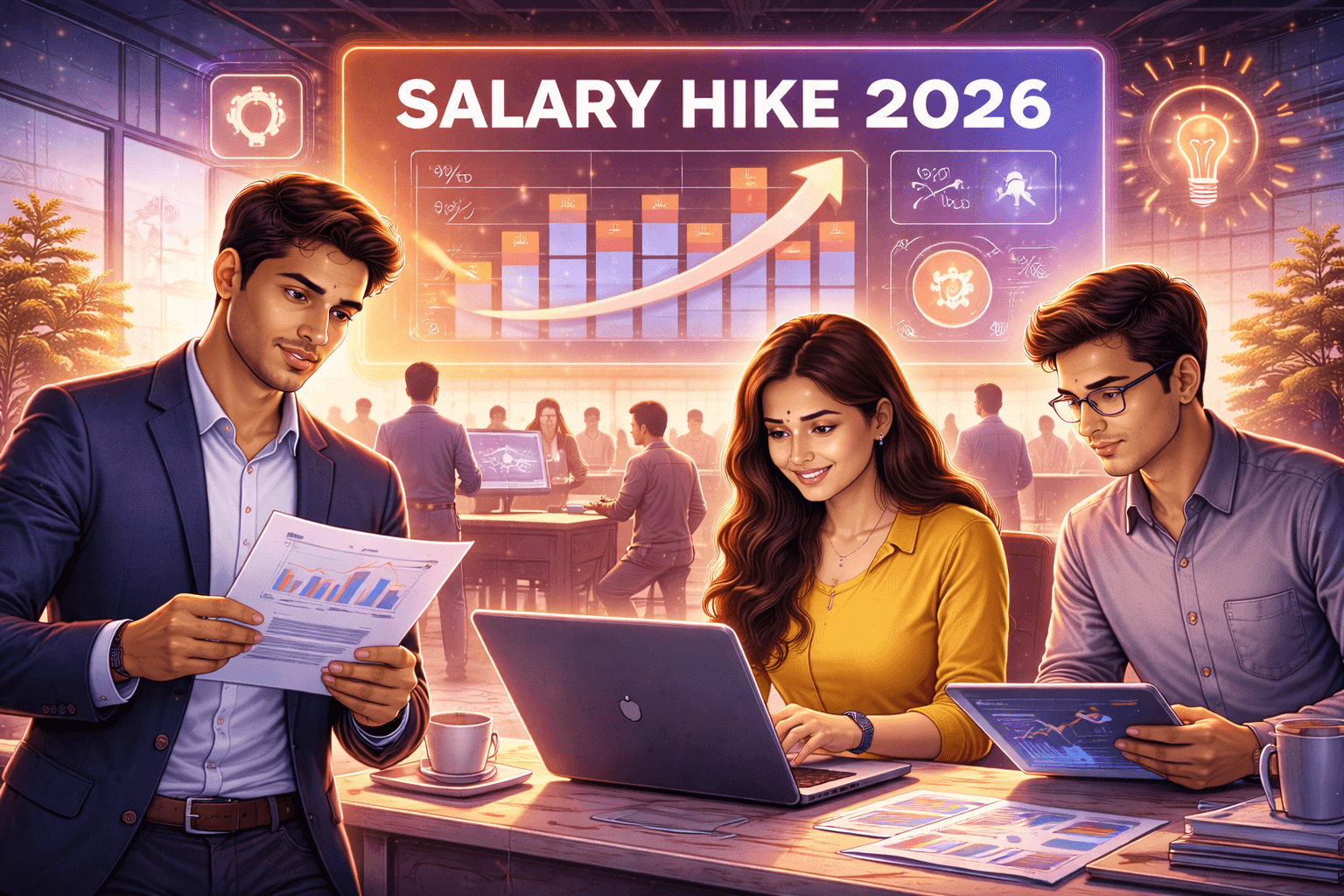
If you’re expecting a big salary jump in 2026, you might want to temper expectations.
According to the latest Aon salary survey, companies across India are likely to offer moderate single-digit to low double-digit salary hikes in 2026, reflecting a cautious hiring environment shaped by AI adoption, global uncertainty, and cost discipline.
The survey highlights a shift in India Inc’s compensation strategy balancing employee retention with profitability and tech transformation.
What the Aon Survey Says About 2026 Salary Hikes
The Aon India Salary Increase Survey suggests:
-
Average salary increments are expected to remain stable compared to 2025
-
Companies are prioritizing critical talent retention over broad-based hikes
-
Performance-linked pay will play a larger role
-
Select sectors may outperform the average
While India remains one of the faster-growing salary markets globally, hikes are not expected to spike significantly.
In short, steady not spectacular.
Why Salary Growth Is Slowing
Several macro and structural factors are influencing compensation decisions:
1. AI and Automation Impact
As companies invest heavily in AI tools and digital transformation, workforce structures are shifting.
-
Automation reduces dependency on some roles
-
Productivity gains help companies manage costs
-
Hiring is more selective and skills-driven
Instead of across-the-board raises, firms are rewarding high-demand AI and digital skills.
2. Cost Optimization in India Inc
Post-pandemic expansion and startup funding cycles led to aggressive hiring in earlier years. Now, many firms are focusing on:
-
Margin improvement
-
Operational efficiency
-
Leaner workforce structures
That naturally moderates salary growth.
3. Global Economic Uncertainty
With geopolitical tensions, inflation concerns, and global demand fluctuations, Indian companies are taking a measured approach to compensation planning.
Even strong domestic growth doesn’t fully insulate firms from global headwinds.
Which Sectors May See Higher Hikes?
While overall increments may remain moderate, some industries could see better growth:
-
Technology and AI services
-
Financial services and fintech
-
Manufacturing and EV sector
-
Consumer goods
-
Digital commerce
Roles involving data science, cybersecurity, cloud infrastructure, and AI integration are likely to command premium increments.
AI Is Reshaping Compensation Strategy
A key takeaway from the survey is how AI is influencing pay structures.
Companies are:
-
Paying more for specialized tech talent
-
Reducing roles vulnerable to automation
-
Linking increments to productivity metrics
-
Increasing performance-based incentives
The traditional annual hike model is slowly evolving toward a more skill-based and performance-driven structure.
What Employees Should Do in 2026
If salary increments are moderate, professionals may need to take proactive steps:
-
Upskill in AI, analytics, or digital tools
-
Focus on high-impact projects
-
Negotiate based on skill demand
-
Explore internal role mobility
-
Strengthen leadership and communication skills
In a selective hiring market, value creation matters more than tenure.
The Bigger Workforce Trend
India’s labour market remains resilient, but it is changing.
We are entering a phase where:
-
Quality of skills matters more than quantity of hires
-
AI transformation is influencing workforce strategy
-
Compensation models are becoming more strategic
-
Retention is targeted, not blanket-based
Salary growth is still happening just more strategically.
Final Takeaway
The Aon survey signals stability, not slowdown.
India Inc is still growing. But companies are cautious, strategic, and increasingly AI-driven in their workforce decisions.
For employees, the message is clear:
The future of salary growth may depend less on annual cycles and more on your adaptability to the AI-powered workplace.
Suggested Articles
 General
Ather CEO: Startups Drive EV Shift, PLI Needs Rethink
Ather Energy's CEO Tarun Mehta argues startups are the true 'engine' of India's EV transition, challenging current go...
Read Article arrow_forward General
 General
IIT Grad's Stark Reality: Startup Life Beyond the Hype
An IIT graduate reveals the harsh truths of the startup ecosystem after leaving a high-paying INR 28 Lakh job, challe...
Read Article arrow_forward Startups
Bharat Taxi Launch Signals a Shift Toward Zero-Commission Mobility Platforms in India
Bharat Taxi introduces a zero commission ride-hailing platform in India, enabling drivers to retain full earnings and...
Read Article arrow_forward