

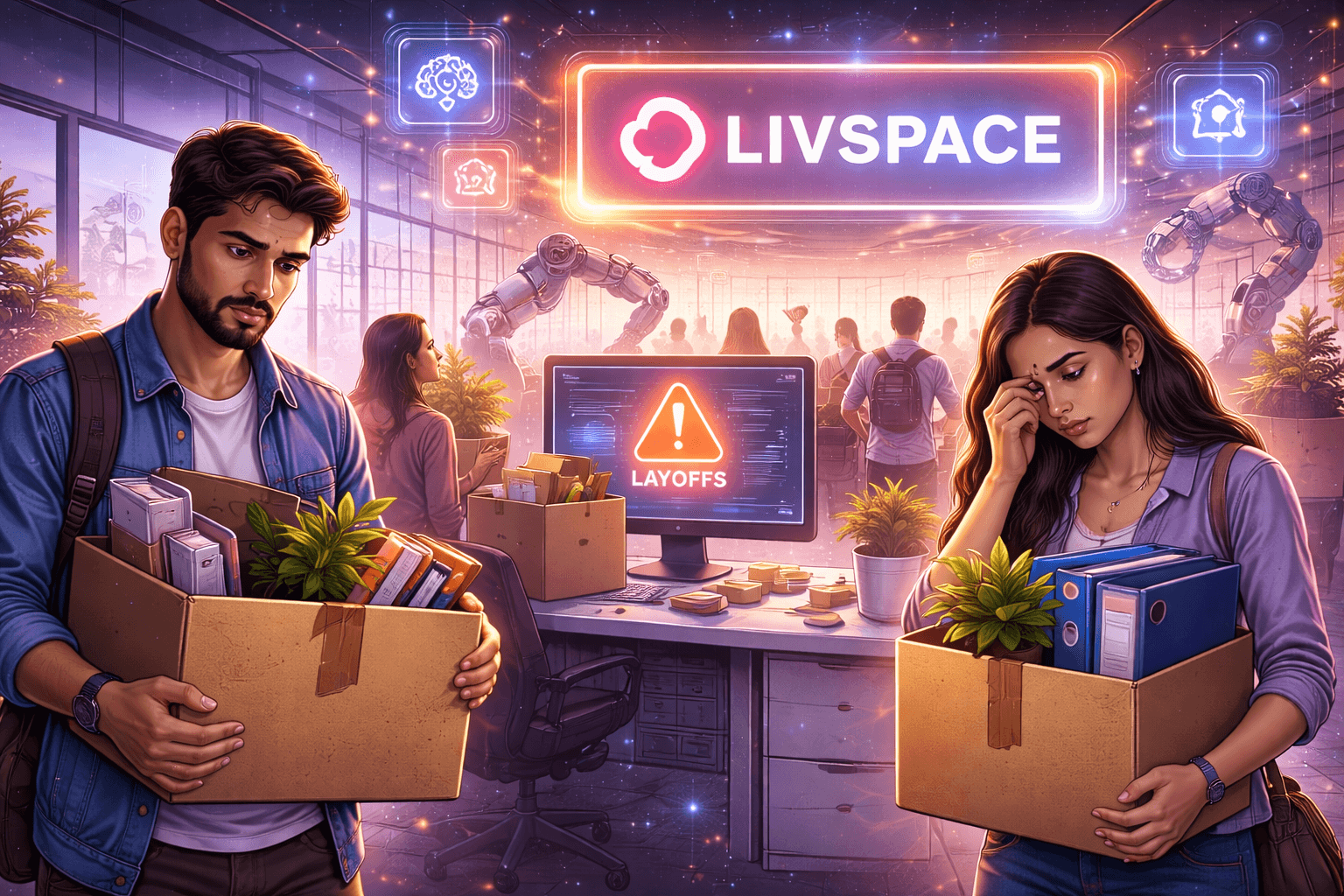
India’s home interior platform Livspace is undergoing a major transformation.
The company has reportedly laid off around 1,000 employees as part of a broader restructuring linked to its AI-driven transition strategy. The development also coincides with the exit of a cofounder, marking a significant leadership and operational shift for the startup.
The move highlights a growing trend in India’s startup ecosystem companies recalibrating workforce strategies as artificial intelligence reshapes business models.
Why Livspace Is Cutting Jobs
According to recent reports, the job cuts are tied to Livspace’s efforts to:
-
Increase operational efficiency
-
Automate processes using AI tools
-
Improve profitability
-
Streamline design and backend operations
-
Reduce costs amid tighter funding conditions
Startups across sectors have been moving toward AI-powered automation, particularly in design, customer engagement, logistics, and back-office functions.
For a home interior platform like Livspace, AI can significantly optimize:
-
3D design rendering
-
Space planning algorithms
-
Vendor matching
-
Project cost estimation
-
Customer experience workflows
As automation increases, certain manual roles may become redundant.
The Cofounder Exit: What It Signals
Alongside workforce restructuring, reports indicate a cofounder has stepped away from active leadership.
Leadership exits during restructuring often indicate:
-
Strategic realignment
-
Shift toward tech-first operations
-
New long-term growth strategy
-
Operational consolidation
While leadership transitions are not uncommon in maturing startups, they often coincide with changes in product direction and corporate strategy.
AI and Startup Workforce Restructuring
Livspace’s layoffs reflect a broader pattern in India’s startup ecosystem.
Over the past two years, startups have:
-
Reduced headcount
-
Focused on profitability over rapid expansion
-
Adopted AI to automate repetitive tasks
-
Tightened operational structures
AI-driven automation is especially impactful in:
-
Customer support
-
Design processes
-
Data analysis
-
Supply chain coordination
-
Marketing automation
While AI improves efficiency, it can reduce demand for certain roles particularly mid-level operational positions.
What This Means for the Startup Ecosystem
Livspace’s decision underscores a critical shift:
Startups are no longer just growth-focused. They are now efficiency-focused.
In the current funding environment, investors expect:
-
Sustainable revenue models
-
Lower burn rates
-
Higher margins
-
Scalable tech infrastructure
AI adoption is increasingly seen as a path to achieving those goals.
However, workforce reduction also raises questions about:
-
Employee reskilling
-
Transition support
-
The human cost of automation
-
Long-term impact on startup culture
The Bigger Picture: AI’s Double-Edged Impact
Artificial intelligence is helping startups:
-
Improve speed
-
Reduce manual errors
-
Lower operational costs
-
Deliver personalized customer experiences
But it also forces difficult decisions around staffing and restructuring.
For India’s workforce, this trend reinforces the importance of:
-
Upskilling in AI-related competencies
-
Moving toward creative, strategic, and tech-augmented roles
-
Adapting to evolving job descriptions
What Happens Next for Livspace?
Moving forward, Livspace is likely to:
-
Deepen AI integration across operations
-
Focus on profitability
-
Optimize vendor and customer processes
-
Strengthen core technology infrastructure
The restructuring may position the company for leaner, more tech-driven growth but its long-term success will depend on execution and market demand.
Final Takeaway
Livspace’s 1,000-job cut and AI transition mark a turning point not just for the company, but for India’s startup landscape.
The message is clear:
AI is no longer optional. It is reshaping business models and workforces across industries.
The challenge for startups will be balancing efficiency with responsibility as automation accelerates.
At Wasupp.info, this development reflects a deeper transformation in how technology and employment intersect in India’s digital economy.
Suggested Articles
 General
OpenClaw: China's AI Ambition and Global Impact
Explore China's aggressive 'OpenClaw' strategy in Artificial Intelligence, its vast investments, technological prowes...
Read Article arrow_forward General
Super Micro Employees Charged with Smuggling AI to China
U.S. prosecutors have charged Super Micro employees with allegedly smuggling critical AI technology to China, highlig...
Read Article arrow_forward
General
AI-Powered Cyber Heist: Mexico Suffers Massive Data Breach
Hackers leveraging artificial intelligence have reportedly stolen hundreds of millions of Mexican government and priv...
Read Article arrow_forward General
Startup Funding Plummets: USD 139M Raised, Down 59% YoY
ETtech Deals Digest reveals a sharp decline in startup funding, with only USD 139 million raised this week, marking a...
Read Article arrow_forward