

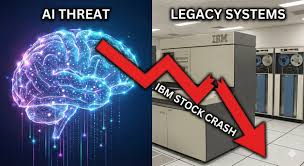
The AI Revolution: A Double-Edged Sword for Enterprise IT
The relentless march of Artificial Intelligence (AI) is reshaping industries, redefining business models, and, crucially, challenging the very foundations of enterprise technology. While AI promises unprecedented efficiencies, innovation, and growth for forward-thinking organizations, it simultaneously casts a long shadow over legacy software systems, threatening to render them obsolete. At the forefront of this disruption are companies like IBM, which have historically built their empires on providing robust, mission-critical systems to large enterprises. The question isn't if AI will impact these systems, but how profoundly, and who will bear the brunt of this technological upheaval.
The global spending on AI is projected to soar, with estimates reaching hundreds of billions of USD in the coming years. This investment is not just in new AI models or applications, but in entirely new ways of processing data, automating decisions, and interacting with technology. This paradigm shift demands agility, scalability, and a modern infrastructure – qualities often lacking in traditional legacy environments.
Understanding Legacy Systems and Their Vulnerabilities
Legacy systems typically refer to outdated computer systems, programming languages, or applications that are still in use because they fulfill a specific purpose within an organization. Often, they are complex, expensive to maintain, and difficult to integrate with newer technologies. These systems might run on mainframes, use proprietary databases, or be written in languages like COBOL, Ada, or older versions of Java and C++.
- High Maintenance Costs: Maintaining legacy systems often requires specialized skills that are becoming increasingly rare, driving up operational expenses.
- Scalability Issues: Designed for an era of less data and fewer users, scaling these systems to meet modern demands is challenging and costly.
- Integration Headaches: Connecting legacy systems with modern cloud services, APIs, and AI tools is a complex, often bespoke, endeavor.
- Security Risks: Older software may have unpatched vulnerabilities, making them prime targets for cyberattacks.
- Lack of Innovation: The rigid architecture of legacy systems inhibits rapid development and deployment of new features, including AI capabilities.
For decades, these systems were the backbone of global commerce, powering everything from banking transactions to airline reservations. However, the rise of cloud computing, microservices, and now AI, exposes their inherent limitations.
How AI Accelerates the Obsolescence of Legacy Software
Artificial Intelligence isn't merely an incremental improvement; it's a foundational shift. Its impact on legacy software is multifaceted:
- Automation of Knowledge Work: AI can automate tasks previously requiring human intervention and often processed by legacy applications, from customer service inquiries to complex data analysis. This reduces the need for the manual interfaces and processes that legacy systems were designed to support.
- Superior Data Processing and Analytics: Modern AI platforms excel at processing vast quantities of structured and unstructured data, extracting insights far beyond the capabilities of traditional business intelligence tools built atop legacy databases. This capability drives a demand for data lakes and real-time analytics, which legacy systems struggle to provide.
- Agile Development and Deployment: AI-powered development tools and platforms enable rapid prototyping, testing, and deployment of new applications. This contrasts sharply with the slow, monolithic development cycles associated with legacy software.
- Resource Reallocation: As businesses invest more in AI capabilities, there's a natural shift in resource allocation – both human and financial – away from maintaining older systems towards building AI-native infrastructure. This AI boom creates shortages in various sectors, including skilled IT talent for legacy systems.
- Disrupting Established Business Models: AI empowers startups and agile competitors to offer services that are faster, cheaper, and more personalized, directly challenging the value proposition of established enterprises still reliant on outdated technology.
IBM's Unique Vulnerability and Response
IBM, a titan of the IT industry, has a long and storied history built on its leadership in mainframe technology and enterprise software. For decades, IBM mainframes, running z/OS, were synonymous with reliability and security, forming the bedrock of critical operations for banks, governments, and Fortune 500 companies globally. While these systems are still highly functional, their very success now presents a challenge in the AI era.
- Deep Entrenchment in Legacy: IBM's vast client base often has decades of investment in IBM hardware and software. Modernizing these environments is a colossal undertaking, often fraught with data migration complexities and business disruption risks.
- Cultural and Structural Inertia: Shifting a company of IBM's size and legacy focus towards a cloud-native, AI-first mindset requires significant cultural transformation, retraining, and divestiture from old ways of thinking.
- Competition from Cloud-Native AI: Hyperscale cloud providers like AWS, Microsoft Azure, and Google Cloud offer AI services that are natively integrated into their scalable, flexible infrastructure, often at a more competitive price point than traditional enterprise solutions. IBM has made significant strides with its own cloud offerings and Red Hat acquisition, but the catch-up game is intense.
- Talent Shift: The demand for AI and cloud skills far outpaces that for legacy system maintenance. This shift impacts recruitment, retention, and the ability to innovate internally.
Despite these challenges, IBM is not standing still. The company has made substantial investments in hybrid cloud, quantum computing, and its own AI platform, Watson. The acquisition of Red Hat for USD 34 billion underscored its commitment to open-source and hybrid cloud solutions, aiming to bridge the gap between legacy on-premise systems and modern cloud environments. Furthermore, companies like NatWest are expanding AI across banking functions, demonstrating that even traditional sectors are embracing these shifts, often with partners who can facilitate the transition.
IBM's strategy hinges on becoming the leading hybrid cloud and AI company, enabling clients to integrate AI into their existing infrastructure rather than forcing a complete rip-and-replace. This involves developing AI tools that can interact with mainframe data, providing AI-powered automation for IT operations, and leveraging technologies like AI-driven code modernization to help clients transform their legacy applications incrementally. The partnerships formed by Indian IT giants with OpenAI and Anthropic also highlight a broader industry trend of established players embracing cutting-edge AI to drive growth.
Strategies for Legacy Modernization in the Age of AI
For organizations, including IBM's clients, navigating this landscape requires a clear strategy:
- Phased Migration: Instead of a 'big bang' approach, incrementally migrate components of legacy systems to modern, cloud-native architectures, leveraging microservices and APIs.
- Hybrid Cloud Adoption: Utilize hybrid cloud models to run legacy workloads on-premises while leveraging public cloud for new AI-driven applications and data analytics.
- AI-Powered Modernization Tools: Explore AI tools that can assist in code refactoring, identifying dependencies, and even automatically converting older codebases to modern languages.
- Invest in Data Infrastructure: Build robust data lakes and data pipelines that can ingest data from disparate sources, including legacy systems, and make it accessible for AI models.
- Upskilling and Reskilling Workforce: Invest in training programs to equip IT teams with skills in AI, machine learning, cloud computing, and modern development practices.
- Strategic Partnerships: Collaborate with technology providers and consultants specializing in both legacy systems and AI to facilitate a smooth transition.
The Future Landscape: Adaptation or Extinction?
The threat posed by AI to legacy software is not an existential one for the systems themselves, but for the organizations that fail to adapt. Companies that cling too tightly to outdated technology risk being outmaneuvered by more agile, AI-driven competitors. The pressure is immense to evolve, and this evolution demands significant investment, strategic foresight, and a willingness to embrace change.
For IBM, the challenge is particularly acute but also presents an opportunity. By leveraging its deep enterprise relationships and expertise in complex IT environments, IBM can position itself as a trusted partner in this modernization journey. The success will depend on its ability to integrate cutting-edge AI capabilities seamlessly into its hybrid cloud offerings, demonstrating tangible value for clients who need to bridge the gap between their valuable legacy assets and the transformative power of Artificial Intelligence.
The era of AI is not just about building new things; it's also about intelligently transforming the old. The companies that master this balance will thrive, while those that don't, risk being left behind in the wake of the AI revolution.
Suggested Articles
 General
Marvell & Google Partner on AI Chips: A Game-Changing Deal?
Marvell Technology's shares surged on news of a potential collaboration with Google to develop two advanced AI chips,...
Read Article arrow_forward General
The Rising Cost of AI-Generated Code: A Reality Check
Initial hype around AI coding assistance is facing a harsh economic reality. Discover why the costs of using AI to ch...
Read Article arrow_forward General
AI Startup Thinking Machines Secures Nvidia Deal
Philippine AI firm Thinking Machines clinches a pivotal capital and chip supply deal from Nvidia, boosting its capabi...
Read Article arrow_forward General
Sundar Pichai: AI Shift Unlocks Startup Investment Opportunities
Google CEO Sundar Pichai highlights the 'AI shift' as a monumental opportunity for startups and investors, transformi...
Read Article arrow_forward