

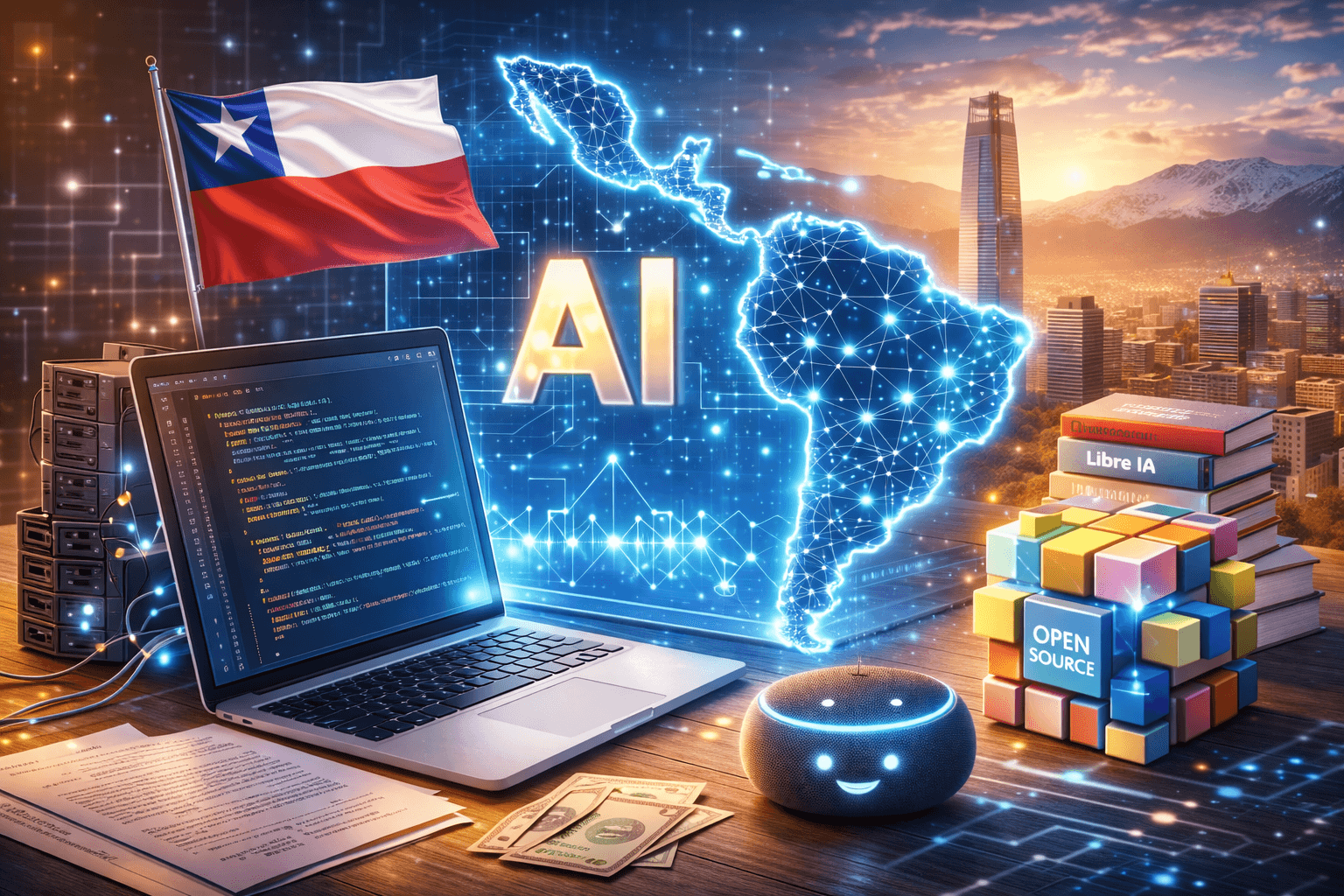
AI is usually shaped in Silicon Valley or Beijing. But that’s starting to change.
Chile has launched an open-source AI model designed specifically for Latin America, marking a major step toward regional AI sovereignty and inclusive technological development. The initiative aims to build an AI system that understands local languages, culture, governance, and regional data realities not just global defaults.
This move signals a broader shift: countries are no longer just adopting AI. They’re building it.
Why Chile’s AI Model Matters
Most large language models today are trained primarily on English and Western datasets. While powerful, they often:
-
Miss regional nuances
-
Struggle with local dialects
-
Reflect foreign cultural contexts
-
Lack alignment with regional policy frameworks
Chile’s open-source AI model aims to change that by focusing on:
-
Spanish language optimization
-
Latin American knowledge sources
-
Public policy use cases
-
Academic and research collaboration
This is about making AI more locally relevant, not just globally scalable.
What “Open-Source AI” Means Here
Unlike proprietary AI systems, an open-source AI model allows:
-
Researchers to study and improve the system
-
Developers to build applications on top of it
-
Governments to deploy it transparently
-
Universities to train students with real AI infrastructure
Open-source AI models also encourage regional collaboration. Countries across Latin America could adapt and contribute to the model, strengthening technological independence.
The Push for AI Sovereignty
Chile’s move fits into a larger global trend: AI sovereignty.
Governments are increasingly concerned about relying entirely on foreign AI providers. Issues include:
-
Data privacy
-
Infrastructure dependency
-
Economic concentration
-
Geopolitical risk
By launching a locally developed AI model, Chile reduces reliance on global tech giants and promotes regional digital resilience.
Focus Areas for the Latin America AI Model
The model is expected to support use cases such as:
-
Public administration automation
-
Educational tools in Spanish
-
Research and academic analysis
-
Regional innovation ecosystems
-
Local business solutions
This positions AI as a tool for economic growth and governance, not just commercial profit.
How This Impacts the Global AI Landscape
Chile’s initiative adds to a growing list of countries investing in national AI models. Instead of a few dominant global systems, the future may include:
-
Region-specific AI systems
-
Multilingual language models
-
Government-backed AI research hubs
This decentralization could lead to more culturally sensitive, ethically aligned AI tools.
The Bigger Picture
AI development is no longer just about scale. It’s about representation.
Chile’s open-source AI model signals that regions want AI systems reflecting their realities language, culture, laws, and social context.
That shift matters.
Because the next phase of AI won’t just be about who builds the biggest model. It will be about who builds the most relevant one.
At Wasupp.info, this is the kind of development that shows how AI is becoming more regional, inclusive, and strategically important.
Suggested Articles
 Artificial Intelligence
India AI Impact Summit 2026: World Leaders Converge to Shape the Future of AI
Global leaders gathered at the India AI Impact Summit 2026 in New Delhi to discuss responsible AI, policy frameworks,...
Read Article arrow_forward General
Bihar Diwas: Tech, Education, Culture Converge in Grand Celebration
Bihar Diwas 2026, inaugurated by CM Nitish Kumar, showcased the state's rich heritage, educational strides, and techn...
Read Article arrow_forward General
BazaarNow Eyes $9 Mn Funding Round Amidst Quick Commerce Surge
Exclusive details emerge as quick commerce startup BazaarNow reportedly seeks USD 9 million in fresh funding, signali...
Read Article arrow_forward General
Literary World Grapples with AI: Can Publishers Detect Automated Books?
The literary world faces an unprecedented challenge as AI-written books flood submissions. Publishers struggle to dif...
Read Article arrow_forward