

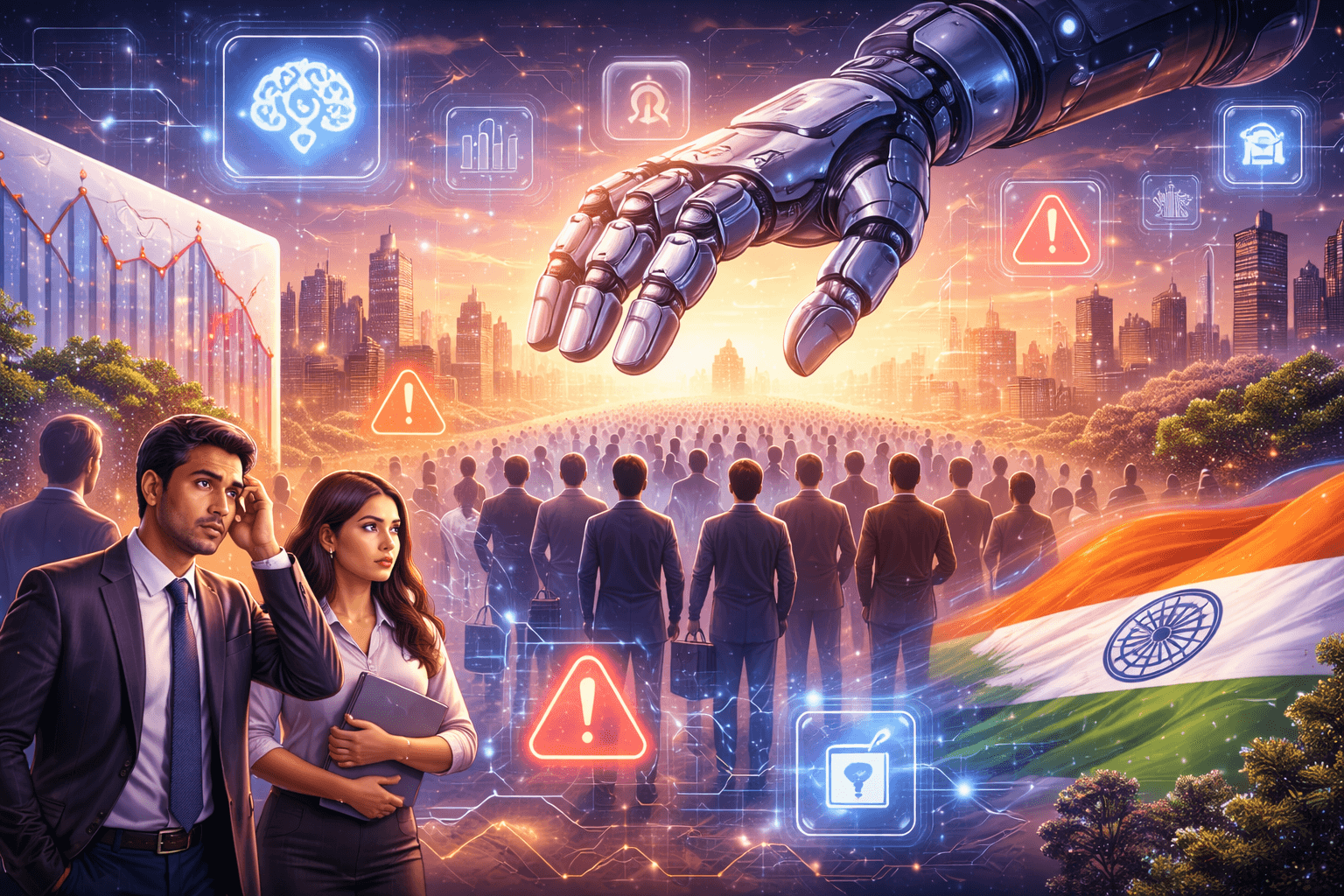
Artificial intelligence promises growth and innovation but it also brings challenges, especially for labour markets worldwide.
According to International Monetary Fund Managing Director Kristalina Georgieva, India faces a potential AI-driven job shock that could impact millions of people entering the workforce each year if policymakers don’t act fast.
Her warning comes amid growing global debate over the future of work in an AI-driven world a theme emphasised at recent international summits focusing on artificial intelligence and economic growth.
What the IMF Chief Warned About India’s AI Job Risk
Georgieva highlighted that artificial intelligence could reshape labour markets significantly boosting productivity and growth but also creating job displacement, especially for young workers and entry-level positions.
She pointed out that while AI may lift overall economic output and help grow GDP in many countries (including potentially boosting global growth by around 0.8%), it could also displace traditional jobs and widen gaps between those with advanced AI skills and those without.
In India’s context with its large, youthful workforce entering the job market every year — this risk is even more acute. Millions of people could struggle to find suitable employment if the economy does not adapt fast enough.
How AI Could Impact Jobs in India
IMF research suggests that AI’s impact on jobs will vary by role and economy. Globally, about 40% of jobs could be affected by changes in tasks due to automation or AI integration.
In advanced economies, this percentage could be even higher, up to 60%, but India’s unique position with a large informal sector and different employment patterns means tailored policy responses are essential.
The impact isn’t just job losses. In many cases, AI will alter job roles, requiring workers to develop new skills or transition into different career paths.
Why Young Workers Are Most at Risk
Entry-level roles which many recent graduates and first-time job seekers rely on tend to involve repetitive tasks that AI systems can automate more easily.
When such roles shrink:
-
Competition for remaining jobs increases
-
Fresh graduates face longer job searches
-
Wage growth may stagnate
-
Inequality could widen
IMF leaders have compared this phase of AI-driven labour market disruption to a “tsunami,” coming fast and affecting a broad segment of the workforce unless proactive steps are taken.
The Opportunity Side of AI
It’s not all risk.
AI adoption also offers opportunities:
-
Enhanced productivity in multiple sectors
-
Creation of new job categories
-
Higher economic growth potential
-
Better digital services and innovation
For India, strategic adoption of AI could help realise the government’s “Viksit Bharat” (Developed India) vision by fostering innovation and driving economic progress.
What Policymakers and Businesses Must Do
Managing the risks and benefits of AI means:
-
Investing in skill development and reskilling programs
-
Updating education to focus on AI-complementary skills
-
Supporting startup ecosystems and innovation clusters
-
Implementing smart labour policies and safety nets
-
Encouraging lifelong learning and worker adaptability
Experts suggest countries that balance innovation with guardrails and social protections stand to benefit most from AI in the long run.
Why This Matters for India’s Economy
India’s demographic dividend is one of its greatest economic strengths but it may also be its biggest vulnerability if AI and automation outpace workforce preparation.
With millions entering the job market every year, the difference between opportunity and unemployment could come down to a nation’s ability to:
-
Equip workers with future-ready skills
-
Foster new sectors of AI-driven employment
-
Support smooth labour market transitions
In short, the AI job shock warning isn’t just a headline. It’s a call to action.
Final Takeaway
AI will shape the future of work but how it affects workers depends on policy, education, and timely adaptation.
India has enormous potential in the AI era, but that potential must be matched with strategic workforce planning and inclusive growth strategies if it’s to benefit people entering the workforce, rather than leaving them behind.
Suggested Articles
 General
The Art of AI Prompts for Personal Finance: An MIT Perspective
Discover how mastering AI prompt engineering can transform your personal finance. Learn strategies from an MIT profes...
Read Article arrow_forward General
Rox AI Soars to $1.2B Valuation: A New Sales Automation Unicorn
Sales automation startup Rox AI achieves a remarkable $1.2 billion valuation, marking a significant milestone in the ...
Read Article arrow_forward General
Unlocking Potential: The North Eastern Science & Technology Cluster
Explore the North Eastern Science & Technology Cluster (NEST), a pivotal initiative transforming India's NER through ...
Read Article arrow_forward General
Tesla's Mega AI Chip Fab to Launch: Musk's Vision Unfolds
Elon Musk announces Tesla's massive AI chip fabrication project will begin in seven days, marking a significant leap ...
Read Article arrow_forward